

Nexa TechNexa Tech

Products

The hardware, in full detail.

Every nurse call system comes down to devices on a wall. This is the range we specify and integrate: what each device does, how it behaves under failure, and the engineering detail a specifier actually needs.

Platform
EZ CALL IP
Manufacturer
Schrack Seconet
Range
10 devices · 3 groups

How the range fits together

One platform, three layers of hardware.

The range divides cleanly. Call units are what patients and staff physically press. Displays are how a call is announced and answered. Location devices are what removes the manual step, registering presence or raising duress without anyone reaching for a button. Every device runs on the same platform, so mixing them is a specification decision rather than an integration problem.

Speech or non-speech decides most of the specification.

The first real question on any project is whether staff need to talk to the room before they walk to it. Speech changes the display selection, the cabling and the cost. In an acute ward it usually pays for itself; in a residential home the answer is often no, and an over-door light with a supervised call point does the job better. We would rather settle that early than reprice a scheme later.

The environment picks the hardware, not the other way round.

A bedhead in a private room, an ensuite pull cord, and a cell terminal in a secure unit are the same function in three different materials. Choosing between them is a risk-assessment exercise (ligature risk, vandalism, infection control, reach from the floor), which is why we schedule devices room by room rather than repeat a standard layout across a floor plate.

Displays and consoles

How a call is announced, read and answered. The layer runs from a full colour touchscreen at the bedside to a supervised over-door lamp, and most wards run several of them together on the same platform.

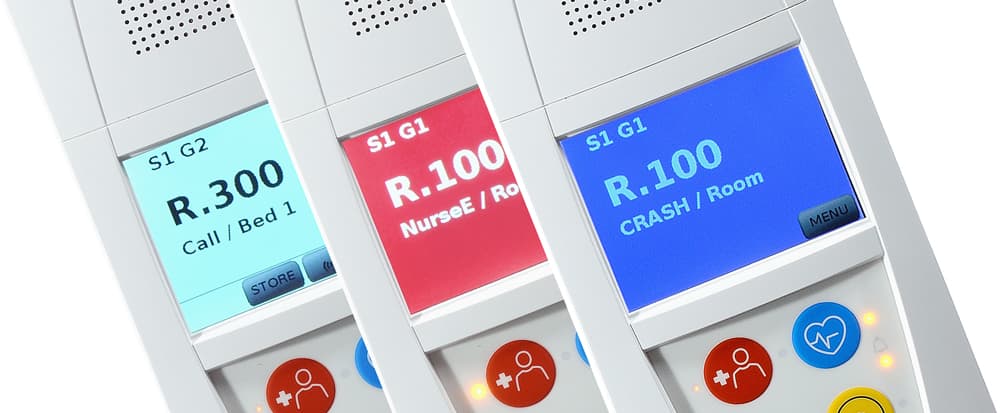
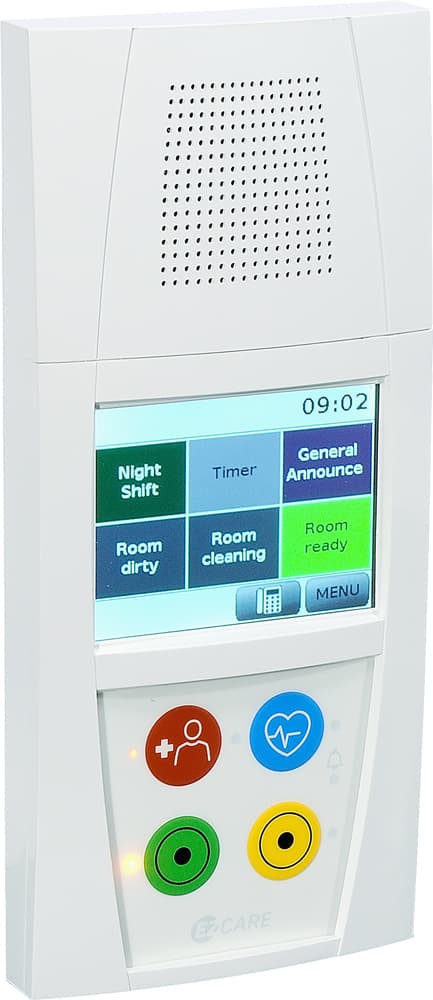
CT Touch room display with its touchscreen showing shift and room-status tiles above four coloured call buttons01 / EZ CALL IP
CT Touch display finish and colour variants
Specification
IP, conventional bus or star cabling (mixable in one system)
Specification
Integrated RFID reader, two presence levels as standard
Specification
Open-air or discreet speech, optional intercom
Specification
Up to six freely programmable soft keys

CT Touch multi-functional display

The colour touchscreen terminal for rooms, corridors and staff bases: call display, two-way speech, RFID presence and configurable soft keys in one wall unit.

The CT Touch is the room terminal the ward works from. It shows which locations are calling, colour-coded by priority and legible at distance, and carries the speech path: staff can answer a call from the wall, speak to one room, address a group of rooms, or make a broadcast announcement from a single key.

Its integrated RFID reader registers staff attendance automatically with user identity, giving a per-user audit trail without anyone pressing anything. Two presence levels are supported as standard, and different call types can be assigned to each, so an emergency reaches everyone while a routine call reaches the assigned carer.

It connects over IP structured cabling, conventional bus or star wiring, and mixed topologies can coexist in one installation. That matters on refurbishments: existing cable can stay in service while new areas run IP, and in IP configurations the embedded Emergency Call System keeps basic call distribution alive if a network switch fails.

Functions

  • Displays call type and precise location, colour-coded by call priority and legible at distance
  • Two-way speech: nurse-to-patient, nurse-to-nurse, announcements and external calls
  • Directed speech to one room, simultaneous announcement to a room group, broadcast to all areas from a single key
  • Automatic staff attendance registration with user identity via the integrated RFID reader
  • Different call types assignable to each of two presence levels
  • Optional on-screen telephone keypad for internal and external calls
  • Hosts small configurable applications for ward workflow, including timed nursing reminders
  • Operable by touchscreen or by easy-clean membrane keypad
  • Adjustable contrast and customisable menus
  • Infrared and RF sensors connect directly for automatic presence and location features

Engineering

  • Connection options: IP structured cabling to BS EN 50173-1, conventional LON bus, or star wiring; mixed topologies supported when extending an existing installation
  • Embedded ECS (Emergency Call System) sustains basic call distribution if a network switch fails in an IP configuration
  • Up to six freely programmable keys presentable on the touch display
  • Speech modes: open-air (hands-free) or discreet (handset); optional intercom
  • Anti-microbial material throughout: in the material itself, not a surface coating, so it is not degraded by scratching
  • Room-side sensors for real-time location connect directly to the unit
  • Wall-mounted; room, corridor and staff base positions
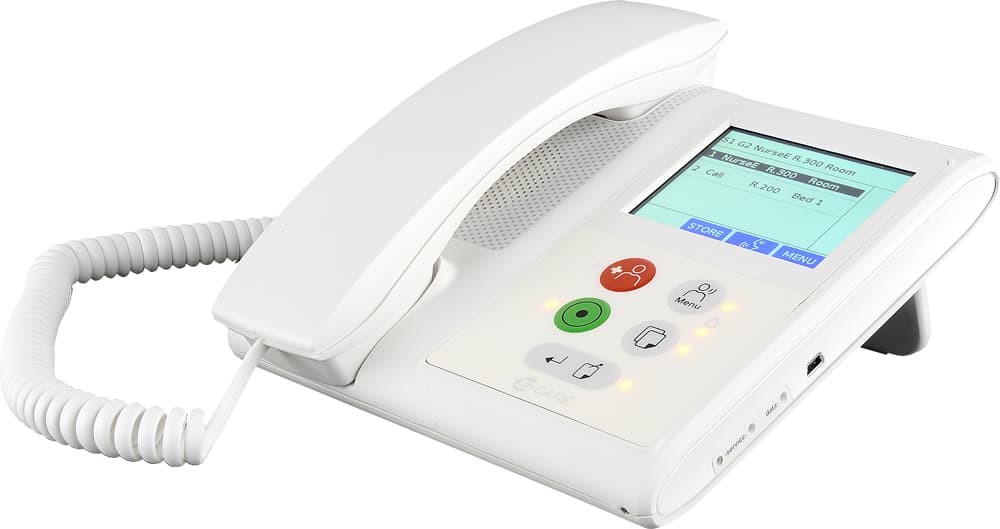
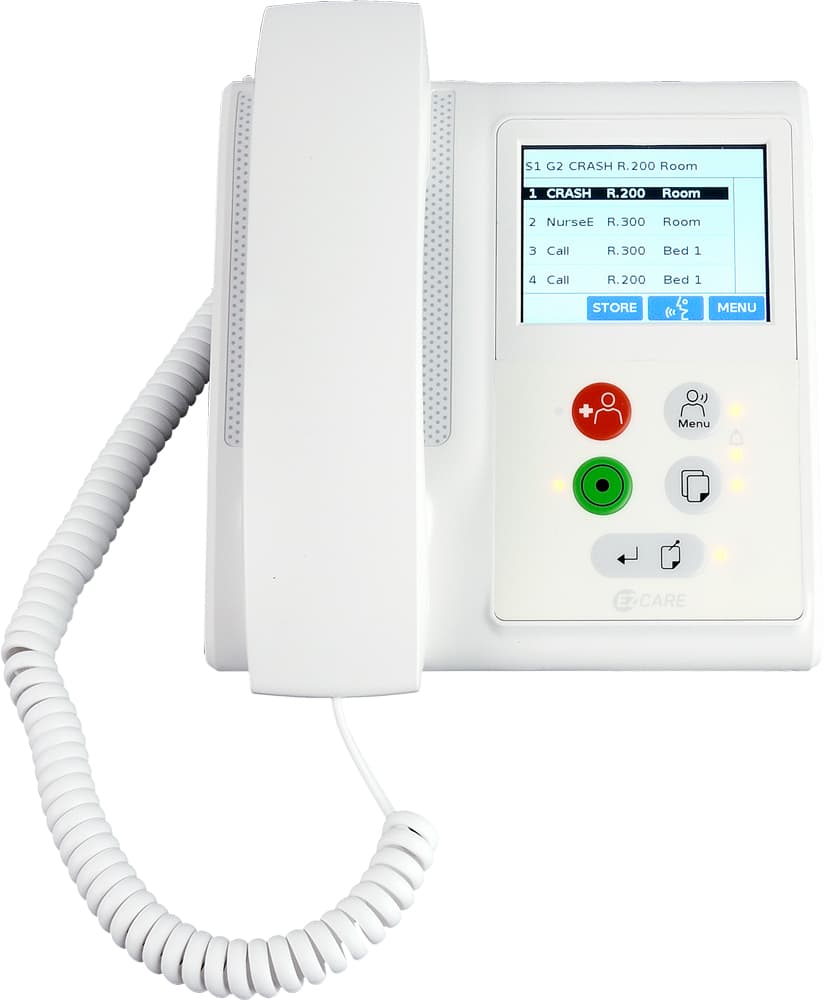
Nurse control station console with touchscreen and handset02 / EZ CALL IP
Nurse control station front elevation showing the touchscreen and keypad
Specification
Desk-mounted or wall-mounted versions
Specification
Full-duplex speech, handset or hands-free
Specification
Priority-ordered scrollable call list
Specification
Touchscreen or tactile membrane keypad

Nurse control station (NCS Touch)

The master console at the staff base: every ward event in one priority-ordered list, full-duplex speech, and the ward's operational controls in one place.

The NCS Touch is where the ward is run from. Incoming calls are listed in priority order with the most urgent and oldest at the top, and the list scrolls. Nothing drops off the bottom unanswered. Staff answer with full-duplex speech, either hands-free through the integral loudspeaker or discreetly by lifting the handset.

Beyond call handling it carries the operational controls: shift mode changeover, care group configuration, pager assignment and announcements to rooms or room groups. Room listening (open-microphone monitoring of a location) is available where it has been clinically agreed.

It is supplied in desk-mounted and wall-mounted versions, operable by touchscreen or by large tactile buttons for staff who prefer a physical keypad, with an easy-clean membrane surface and anti-microbial construction throughout.

Functions

  • Displays and controls all ward-related events in one list
  • Call list ordered by preset priority, most urgent and oldest first, scrollable
  • Call handling and acceptance from the console
  • Staff-to-patient and staff-to-staff speech, full duplex
  • Speech initiated hands-free or by lifting the station handset
  • Announcements to a single room, a room group or a site area
  • Room listening where clinically agreed
  • Shift mode, care group configuration and pager assignment
  • Integral indicator light on the console

Engineering

  • Two mounting formats: desktop and wall
  • Operable by touchscreen or by large tactile buttons as an alternative to touch
  • Easy-clean membrane keypad; clinical white finish
  • Anti-microbial construction specified through the material
  • Open-air speech via integrated loudspeaker; discreet speech via handset
  • Manufacturer identifies energy-saving operation as a design attribute of the unit
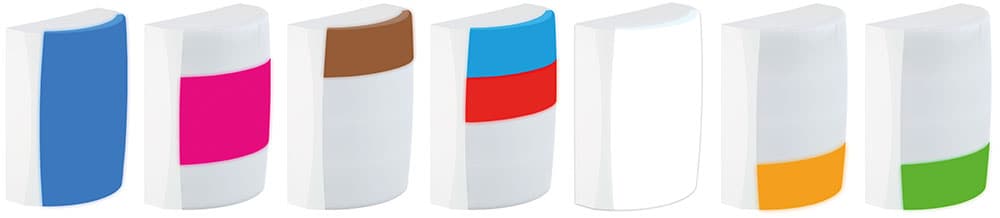
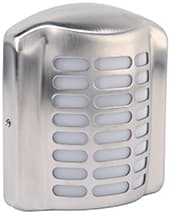
Over-door dome lamp with its four LED segments lit white, red, green and yellow03 / EZ CALL IP
Dome lamp segments lit in different signal colours
Dome lamp cut-out showing red, green and amber segments
Specification
Four LED segments, each individually monitored
Specification
Eight monitored inputs with configurable outputs
Specification
Signal colours certified to VDE 0834 and HTM 08-03
Specification
Anti-ligature stainless cover option

Multicolour LED dome lamp

The supervised over-door lamp: four individually monitored LED segments, freely configurable colours, and eight monitored inputs that bring third-party equipment into the same signalling scheme.

The dome lamp is how a corridor reads a ward at a glance, and this one is built so it can be trusted: each of its four LED segments is individually monitored, so a failed segment is reported as a fault rather than quietly going dark. Multiple segments lit together give long-distance visibility of alarm calls along a corridor.

Colours and combinations are freely configurable (white, red, green and yellow/blue as standard, with magenta, cyan, violet and brown available), covering call types, staff presence, cardiac indication, WC emergency and room states such as quarantine, needs-cleaning or available.

The version with integral electronics also acts as the room controller: it drives and supervises the room's calling units and reports their status back to the main control unit. Eight monitored inputs with configurable outputs bring third-party equipment (drug cabinets, dialysis machines, assistive care units, even the fire alarm) into the same signalling scheme, each shown in its assigned colour. A lower-cost slave version without electronics works as a repeater, and a clip-on sounder module adds audible signalling without extra wiring.

Functions

  • Visual call and presence indication above the door, with optional audible signalling
  • Four visual LED segments, each individually monitored for failure
  • Standard colours white, red, green and yellow/blue; magenta, cyan, violet and brown configurable in addition
  • Freely customisable colour combinations per signal or status
  • Room states such as quarantine, needs cleaning or available shown as distinct indications
  • Version with integral electronics controls and monitors the room's calling units and reports to the main control unit
  • Eight monitored inputs bring third-party devices (drug cabinets, dialysis machines, assistive care units, fire alarm) into the signalling scheme
  • Multiple segments lit together for long-distance corridor visibility
  • Clip-on sounder module adds audible signalling with no additional wiring; tones synchronised across the system
  • Slave lamp version without electronics as a lower-cost repeater

Engineering

  • Signalling types and colours certified against VDE 0834 and HTM 08-03
  • 4 LED segments, all individually monitored
  • 8 monitored inputs; associated outputs freely configurable
  • Ultra-low-voltage LED technology for service life and running cost
  • Two electronics variants: integral room-controller electronics, or slave without electronics
  • Sounder module mounts directly to the lamp base
  • Clinical white casing as standard; V2A stainless steel vandal-resistant cover option for secure environments
  • Curved profile for visibility from an angle along the corridor
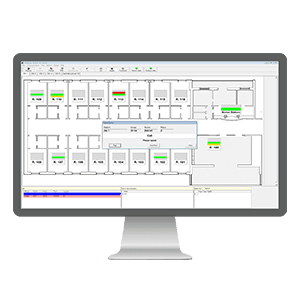
Nurse call workstation software showing a floor-plan view of live call status04 / EZ CALL IP
Specification
Floor-plan and list views, freely combinable
Specification
Timestamped event logging built for VDE 0834
Specification
Mobile devices assigned to bed, room, group or station
Specification
Application supervised by an ECS watchdog

Workstation software suite

The PC side of the platform: floor-plan and list views of live events, mobile device assignment in two clicks, and timestamped logging that turns call activity into evidence.

The workstation suite gives nursing and administrative staff one place to see and manage call traffic. Active calls and staff presence display on imported graphical floor plans or in configurable list views, organised by station, call type and priority. The two view styles combine freely, so a reception desk and a ward office can each see what they need.

Operational administration lives here too. Shift templates change over manually or on a timer: DECT handsets reassign themselves to the night team automatically. Pagers, DECT and mobile phones are assigned to a bed, a room, a room group or a whole station in two clicks, and rooms move between care groups in real time without reprogramming or hardware changes.

Every event is logged with a timestamp, and the data exports into call-exception reports: ward-specific or site-wide analysis of call and response times that a care manager can shape and produce as evidence. Vital Call Monitoring raises an alarm if a room shows no call activity within a predefined period, and the application itself is supervised: a watchdog process raises an alarm on the nurse call system if the software malfunctions.

Functions

  • Graphical floor-plan views from imported plans, alongside configurable list views
  • Calls displayed per station, organised by call type and priority
  • Staff presence display supporting multiple presence types
  • Click-to-talk speech connection to individual rooms on speech-enabled systems
  • Announcements to a single room, a group of rooms or system-wide
  • Manual shift switching via predefined shift templates
  • Time-controlled automatic shift changes, including automatic reassignment of mobile devices
  • Pagers, DECT and mobile phones assigned to a bed, room, room group or station in two clicks
  • Dynamic case management: rooms move between groups or stations in real time, no reprogramming
  • Vital Call Monitoring: automatic alarm if a room shows no call activity within a set period
  • Timestamped logging of all system events
  • Exportable call-exception reports, ward-specific or site-wide, shaped by the care manager
  • Stores real-time location tag information with timestamps when used with the location system

Engineering

  • Event logging with timestamps designed for VDE 0834 compliance
  • Dynamic room and group reassignment provided by the mediGraph software platform
  • Application health supervised by an ECS watchdog that raises a nurse call alarm on software malfunction
  • Scales from a small group of rooms to a complete hospital-wide installation
  • Supported mobile targets: pagers, DECT phones and mobile phones
  • Speech features require a speech-enabled system configuration

Call units

What patients, residents and staff physically operate. Every unit in the range is continuously polled by the system: supervision runs to the button itself, so a dead call point is reported, never discovered.

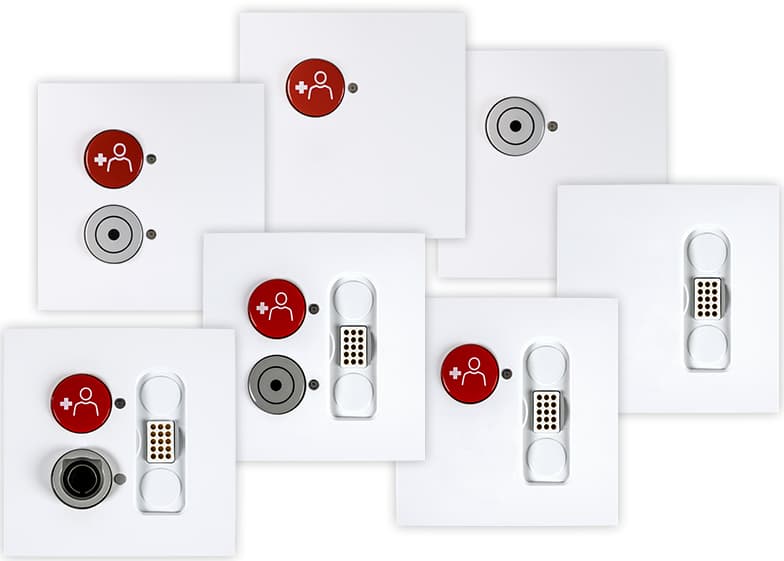
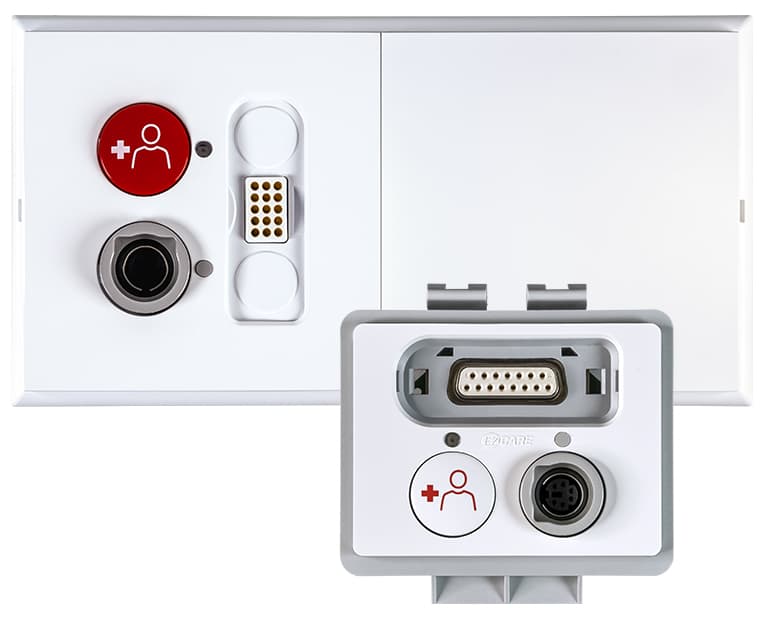
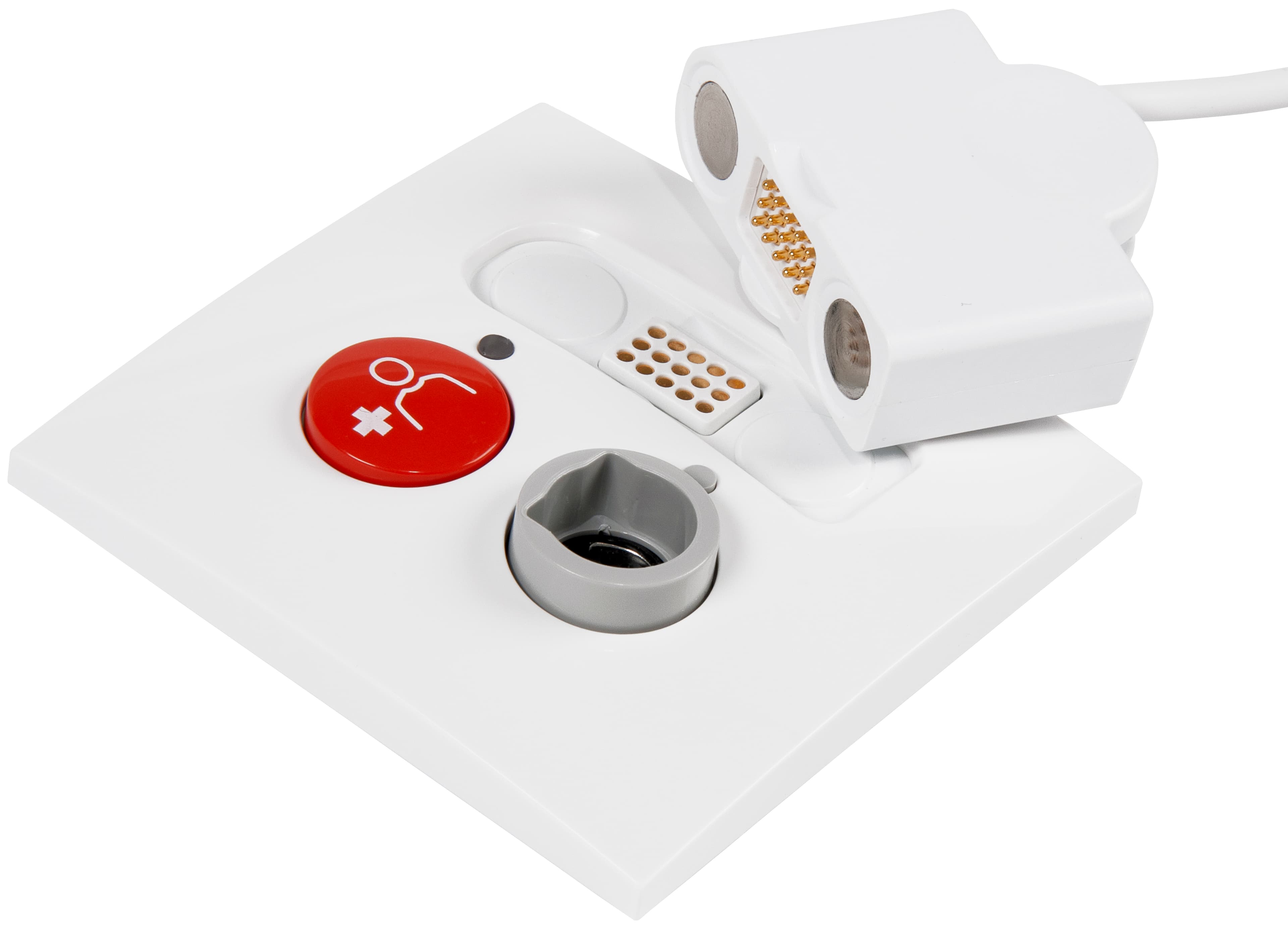
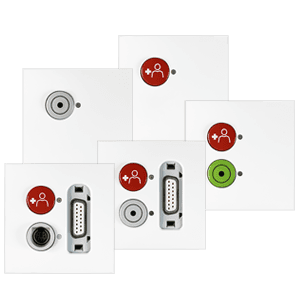
Range of call panels and magnetic socket plates01 / EZ CALL IP
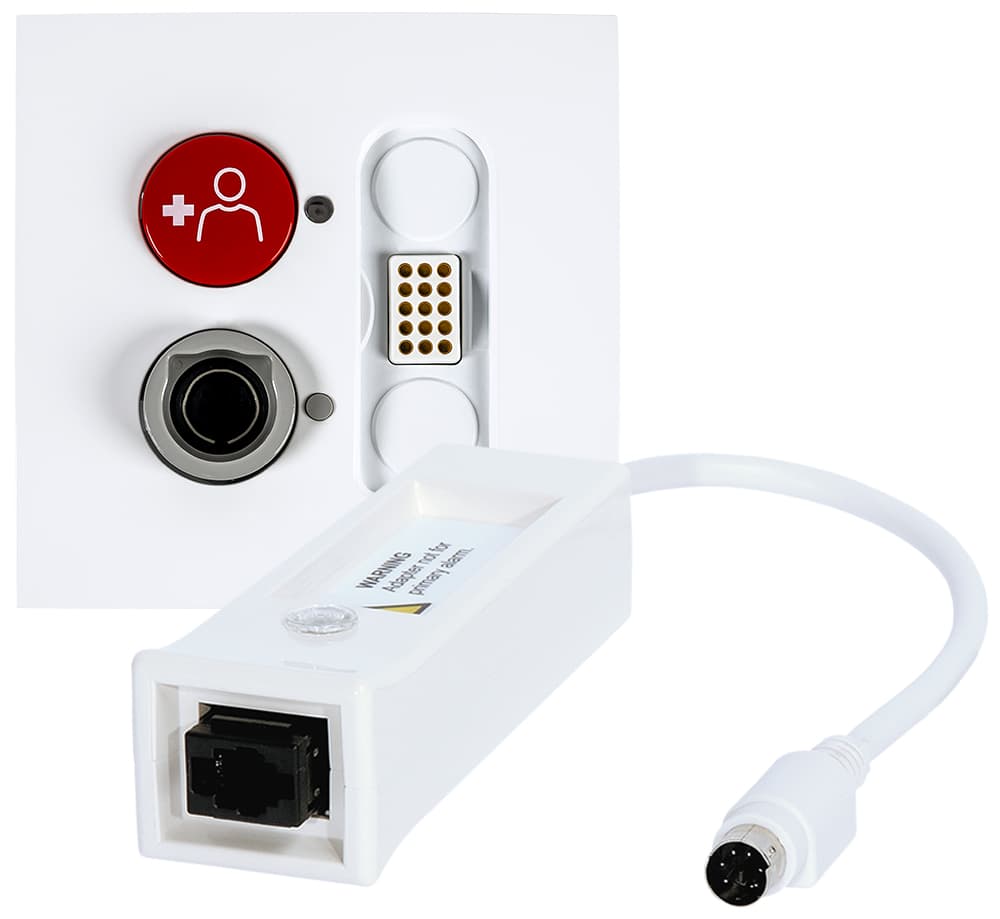
Magnetic socket plate with Mini-DIN connection
Call panel and socket module with a magnetic adapter carrying a multi-pin connector
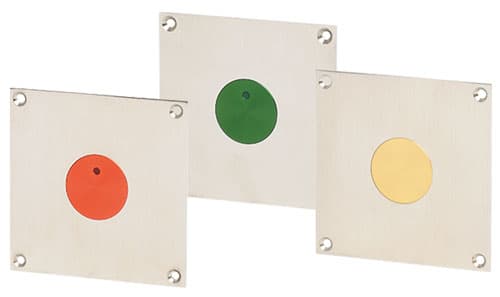
Call panel range cut-out
Specification
Supervised to the button: circuitry continuously polled
Specification
Modular fascia on common backplate electronics
Specification
Designed against DIN VDE 0834 and HTM 08-03
Specification
Anti-microbial through the material, not a coating

Call panels and sockets

The modular wall and bedhead range: call, service, presence and emergency, with the socket plates that bring handsets, sensors and medical equipment into the system.

Call panels raise patient, service and emergency calls; socket plates connect patient handsets and third-party devices into the system. Everything is built as modular fascia plates on common backplate electronics, so a damaged cover swaps in the field without an engineer callout; repair cost and downtime stay low.

The socket range is where the system opens up. DIN and Mini-DIN sockets take assistive devices; magnetic sockets with adapters accept non-system third-party equipment; and the safe-release D-socket takes the patient handset. If the lead is snagged or pulled it releases cleanly instead of damaging the plate, and the system raises an automatic staff alert, so a detached handset is never a silent failure. Connected medical monitoring equipment can raise a call automatically when a monitored threshold is reached.

A service call button with a pictogram lets patients raise non-medical requests without tying up clinical staff, and the Nurse Follower function sounds an audible tone in nearby rooms to summon a colleague, its frequency varying with the acuity of the call. WC pull cords in the same range are anti-ligature as standard, with a splashproof housing for wet areas and an IP67 cord available.

Functions

  • Every unit's circuitry constantly polled by the system for supervised, fail-safe operation
  • Service call button with pictogram, separating non-medical requests from the clinical queue
  • Automatic call raising from connected medical monitoring equipment on threshold
  • DIN and Mini-DIN sockets for assistive care devices
  • Magnetic socket with adapter for non-system third-party devices
  • Safe-release D-socket for handsets: a pulled lead releases cleanly and raises an automatic staff alert
  • Socket interfaces support enuresis sensors, bed and chair exit sensors, PIR power interfaces, pressure mats and LED lights
  • Nurse Follower assist tone in nearby rooms, frequency varying with call acuity
  • WC pull cords anti-ligature as standard, splashproof option, IP67 available
  • Versions with user ID capture, multiple call levels, service call and speech capability
  • Cardiac and code-blue call units with protective cover
  • Trunking adapter modules for hospital containment trunking

Engineering

  • Designed against DIN VDE 0834 and HTM 08-03
  • Socket types: DIN / Mini-DIN, magnetic with third-party adapter, and safe-release D-socket
  • Handset D-socket release generates an automatic staff alert
  • Continuous line supervision: units permanently polled by the system controller
  • Modular plate architecture: fascia separates from backplate electronics for fast field replacement
  • Surface, flush and bedhead trunking mounting; dedicated inserts for horizontal and vertical trunking with DIN sockets for medical devices
  • Stainless steel cover plate options for high-traffic environments
  • Anti-microbial treatment through the material, not degraded by scratching
  • Supported peripherals: enuresis sensors, bed and chair exit sensors, PIR power interfaces, pressure mats, LED lights, medical monitoring equipment
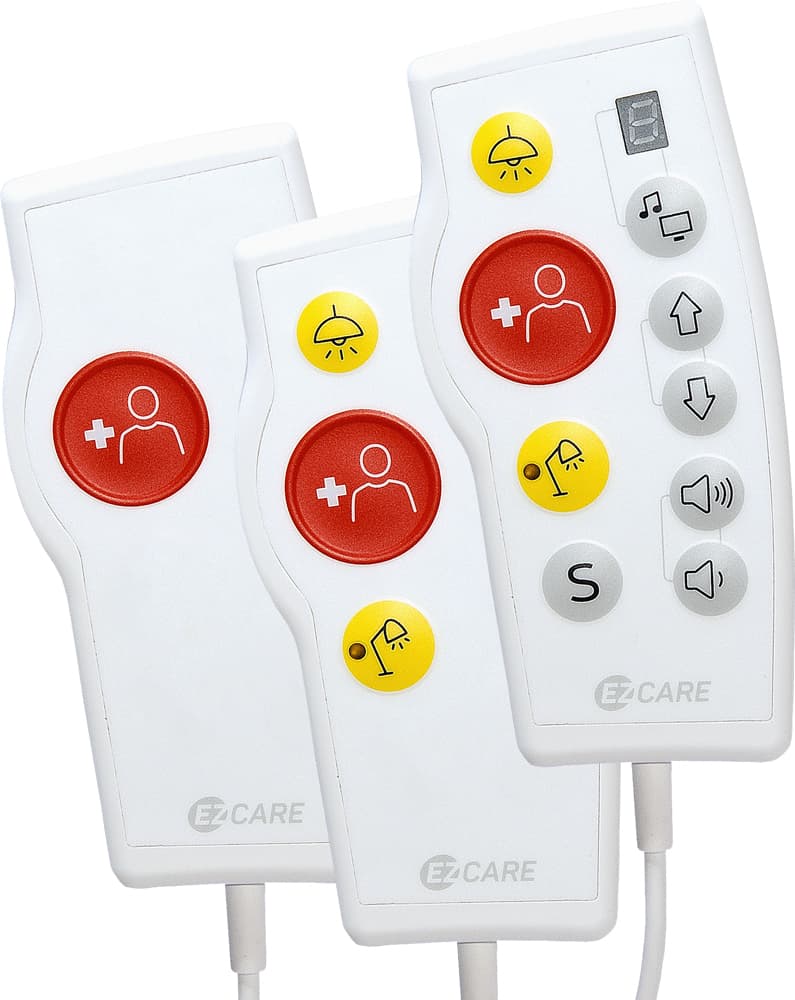
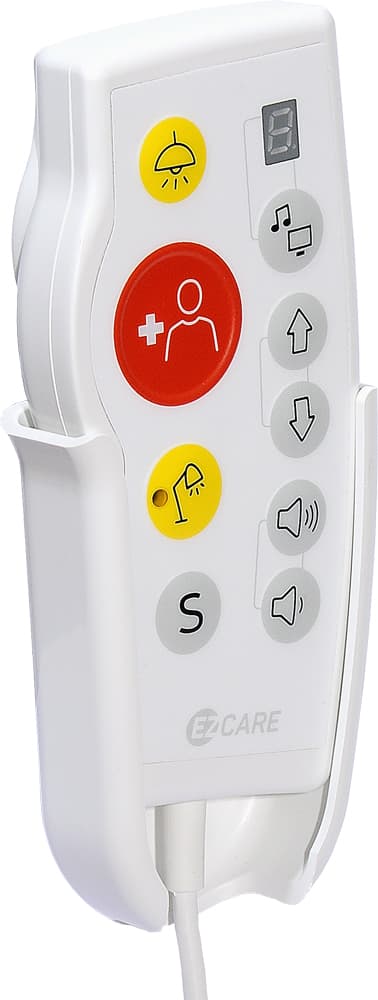
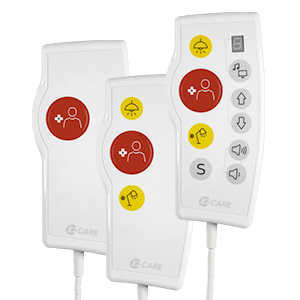
Range of patient handset variants showing call and environmental control buttons02 / EZ CALL IP
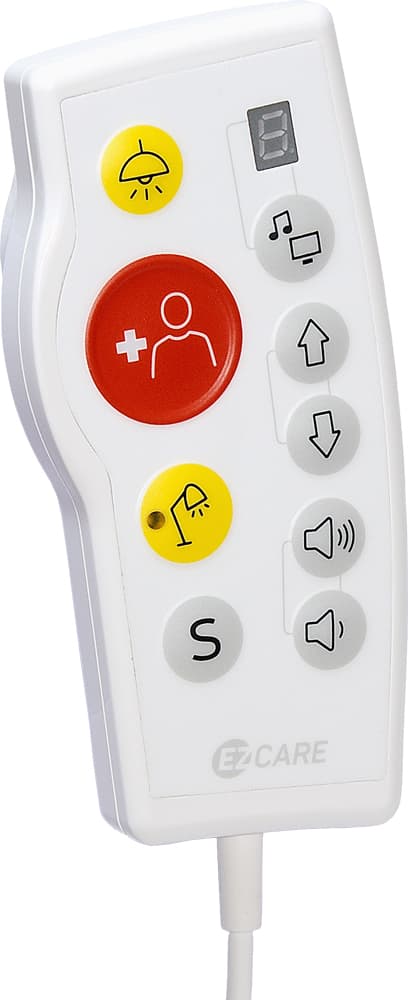
Single patient handset, primary product view
Close-up of the magnetic safe-release D-socket connector
Patient handset seated in its wall bracket
Specification
Cord lengths 3 m, 5 m and 10 m
Specification
Magnetic safe-release D-plug: detaches under load, raises an alert
Specification
3.5 mm audio jack with automatic voice override
Specification
IP67 dip-sterilisable variant

Patient handsets

The one device the patient actually holds: call, speech and bedside environment control on a lead engineered to let go before the patient does.

The handset carries the call button (large, illuminated, with a raised tactile ridge so it can be found by touch in the dark) and, on speech variants, an integral microphone and loudspeaker. In its cradle it works hands-free; held to the ear it behaves like a telephone, and a 180-degree safety feature keeps hands-free working even inverted.

Beyond the call it can carry the bedside environment: room and bed light control with dimming, optional roller shutter control, radio and television control with volume, and a 3.5 mm headphone socket with automatic voice override. An incoming speech call cuts through the entertainment audio.

The connection detail matters most in service: the magnetic safe-release D-plug detaches under load rather than pulling the socket off the wall or the patient out of bed, and the detachment raises a staff alert. An optional second service button, marked S, separates non-clinical requests from the clinical queue. Cords come in 3, 5 and 10 metre lengths, and an IP67 variant is dip-sterilisable for infection-control regimes.

Functions

  • Patient call via a large illuminated button with a raised tactile ridge, findable by touch
  • Reassurance light confirms the call has been raised
  • Optional second service-call button marked S, separating non-clinical requests
  • Two-way speech: hands-free in the cradle, discreet in the hand
  • Room and bed light control with dimming
  • Optional roller shutter, radio and television control with volume
  • 3.5 mm headphone jack with automatic voice override on incoming speech
  • 180-degree safety feature: hands-free operation continues if the unit is inverted
  • Anti-static safety feature

Engineering

  • Magnetic safe-release D-socket: lead detaches under load and the system raises a staff alert
  • Standard cord lengths: 3 m, 5 m and 10 m
  • Integral microphone and loudspeaker on speech variants
  • IP67 variant described by the manufacturer as dip-sterilisable
  • Clinical white finish; anti-microbial material
  • Wall bracket available for cradle mounting at the bedhead
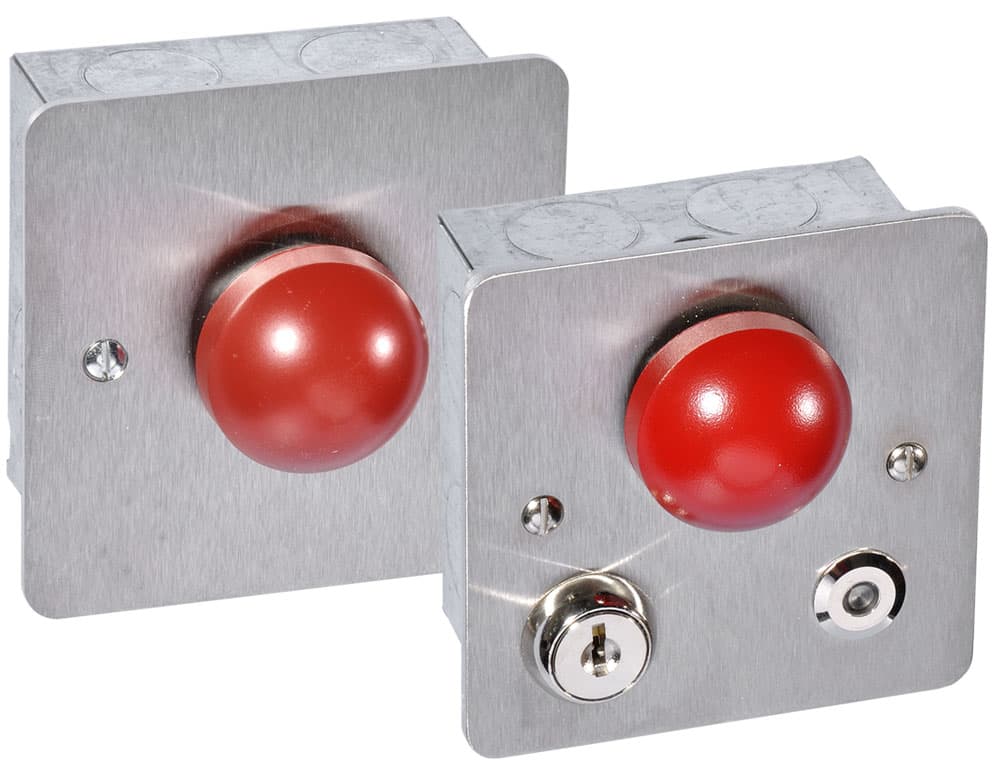
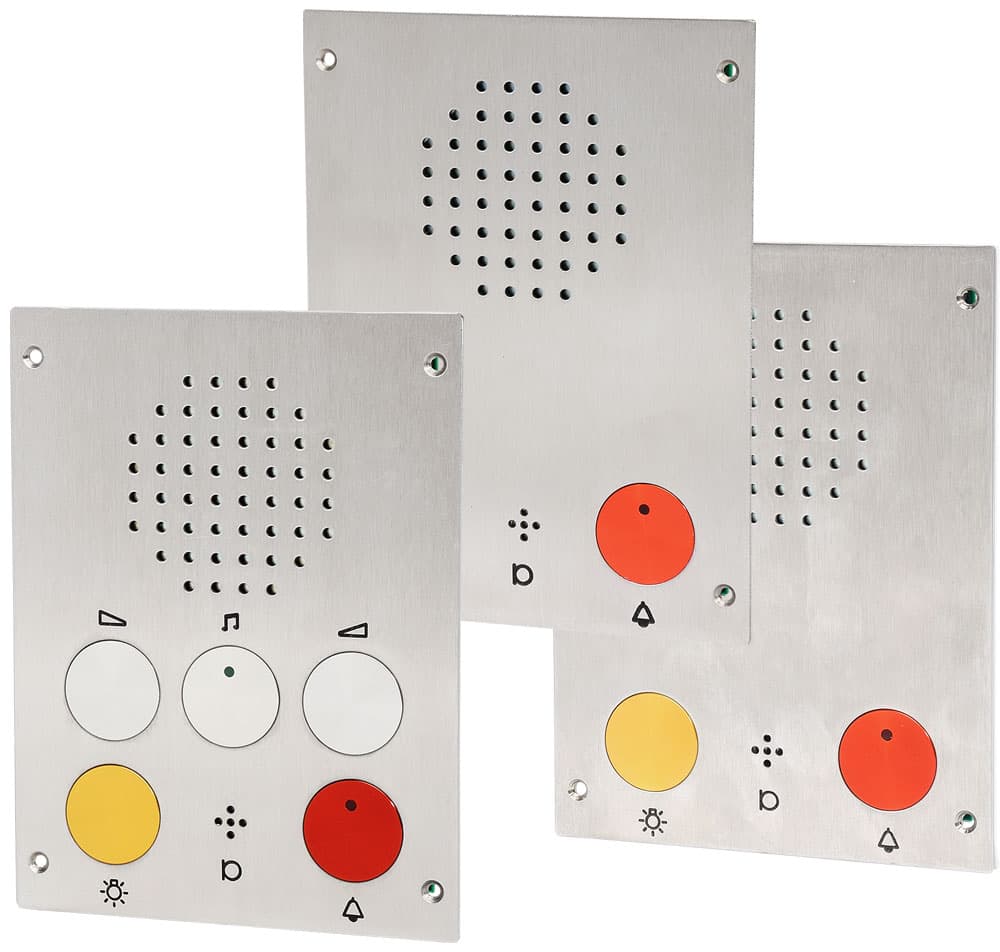
Stainless steel call buttons and plates03 / EZ CALL IP
Stainless steel mushroom push button call point
Stainless steel call unit range cut-out
Specification
Stainless steel plates and covers throughout
Specification
IP65 variant for wet areas
Specification
Tamper-proof fixings with electronic tamper alerts
Specification
Continuously polled, like every unit in the range

Stainless steel call units

The hardened range: mushroom push buttons, keyswitch units and IP65 wet-area call points on stainless steel plates, for environments that punish standard hardware.

Where a standard plastic call point would be broken, removed or worked loose, the stainless range takes over: mushroom push buttons on stainless steel plates, keyswitch-operated units with LED reassurance lamps and audible tones, and presence-button units that enable a second, higher call level once staff register their arrival.

The range runs on the same platform and under the same supervision as every other call unit: circuitry continuously polled, faults detected by the system rather than found on a walk-round. Fixings are tamper-proof, and tamper alerts are raised electronically.

An IP65-rated version covers wet areas (specified by the manufacturer for swimming pool distress alarm points), and V2A stainless steel protective covers are available for over-door lights in the same environments. Service call, speech and multiple call level variants complete the range.

Functions

  • Mushroom push button call point on a stainless steel plate
  • Keyswitch operation option with LED reassurance lamps and audible tones
  • Reassurance lamp fitted as standard on push-button units
  • Green presence button enabling a second, higher call level on staff arrival
  • Speech versions for two-way staff-patient communication
  • Listening facilities where clinically agreed
  • IP65-rated version for wet areas, including pool distress alarm points
  • V2A stainless steel protective covers for over-door lights
  • Service call and multiple call level variants
  • Modular swap-out design to keep lifecycle cost down

Engineering

  • Faceplates and cover plates in stainless steel; overdoor light housings in V2A stainless
  • IP65 ingress protection available
  • Anti-tamper screws; tamper alerts raised electronically
  • Circuitry continuously polled by the system
  • Optional extras: staff attack receivers and triggers, portable alarm triggers, WC alarms, real-time location
  • Intended environments named by the manufacturer: psychiatric hospitals, care homes, prisons, police custody suites, magistrates' courts, detention and remand centres
Stainless steel vandal-resistant cell terminals04 / EZ CALL IP
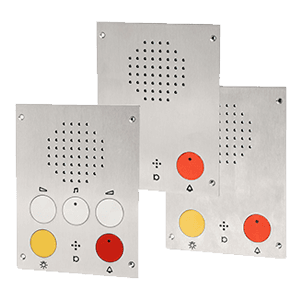
Vandal-proof LED indicator light for cell doors
Specification
Stainless steel, sabotage-protected construction
Specification
Software-assignable inputs and outputs
Specification
Two presence categories, second higher call level
Specification
Links to a cell electronic driving the door signal light

Vandal-resistant cell terminals

In-cell call, presence and speech hardware with software-configurable inputs and outputs. Built for custody, forensic and secure mental health environments.

The cell terminal is the hardened end of the range: a stainless steel call and presence unit designed for rooms where hardware is attacked. Internal and external sabotage protection is built in, fixings are anti-tamper, and interference raises an electronic tamper alert.

Functionally it is a small controller, not a button. Its inputs and outputs are assigned in software rather than fixed in hardware. Call categories, two presence categories, call forwarding, cell light control, light withdrawal activation and socket withdrawal can all be configured per room against the regime and the risk assessment.

The terminal links to a cell electronic module that forwards calls and drives the room's signal light, with vandal-proof LED luminaires and V2A stainless covers for the over-door indication. Speech versions provide two-way staff-to-occupant communication, and ceiling receivers can pick up portable infrared emergency triggers carried by staff.

Functions

  • Occupant call initiation from a hardened, recessed unit
  • Green presence button registering staff arrival and enabling a higher call level
  • Two presence categories assignable
  • Speech path for staff-to-occupant conversation
  • Software-configurable inputs and outputs per room
  • Configurable functions include call categories, call forwarding, cell light control, light withdrawal and socket withdrawal
  • Internal and external sabotage protection with electronic tamper alerts
  • Reception of portable infrared emergency triggers via ceiling receivers
  • Vandal-proof LED luminaire for door indication

Engineering

  • Stainless steel construction, mechanically vandal-resistant
  • Anti-tamper fixings; tamper events alarmed electronically
  • Signalling chain: cell terminal to cell electronic module, which forwards calls and controls the door signal light
  • Circuitry continuously polled by the system
  • V2A stainless protective covers for over-door lights
  • Published IP, IK and ligature test data should be obtained from the manufacturer before specification, not published on the public page

Location and duress devices

The layer that removes the manual step. Presence registers itself when a carer enters the room, and help can be called from a body-worn trigger rather than a fixed point on a wall.

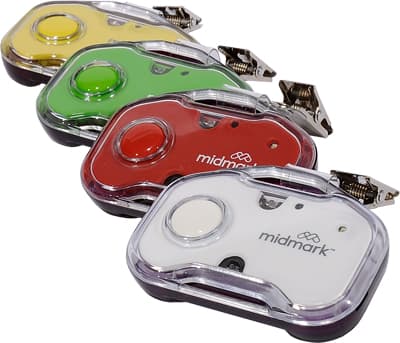
Four automatic presence badges in yellow, green, red and white, each with a belt clip01 / EZ CALL IP
Specification
Registers presence on room entry, hands-free
Specification
Identity and timestamp per registration
Specification
Several badge and tag form factors
Specification
Works with room terminal IR and RF sensors

Automatic presence badges

Worn credentials that register staff presence on room entry: attendance logged with identity and timestamp, without anyone pressing anything.

The badge closes the gap between what happened and what was recorded. When a carer enters a room, their presence registers automatically against their identity: no button, no forgotten press, no unlogged visit. The record carries user and timestamp, building the audit trail response-time reporting depends on.

Presence drives behaviour, not just records: with presence registered, call routing can change. A call in the room reaches the carer already there, escalation timers adjust, and a second call level becomes available. Badges come in several form factors and work with the infrared and RF sensors that connect directly to the room terminals.

Functions

  • Automatic staff presence registration on room entry
  • Per-user audit trail with timestamps
  • Call routing and escalation respond to registered presence
  • Second call level available once presence is registered
  • Location events recorded alongside call events in one activity log
  • Tag information stored with timestamps in the workstation software

Engineering

  • Runs as an application layer on the nurse call platform; the platform is the prerequisite
  • Infrared and RF room sensors connect directly to the room terminals
  • Badge form factors for lanyard and clip wear
  • Receiver coverage and density are design decisions; we confirm them by survey, room by room
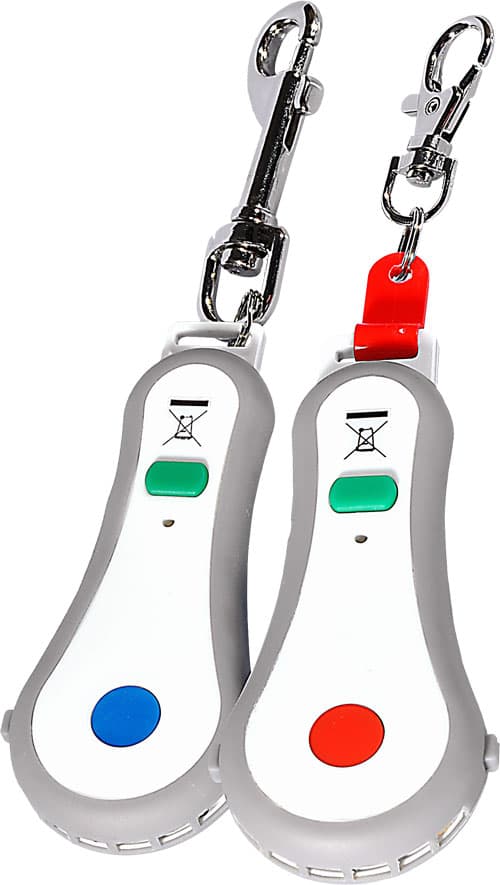
Portable staff attack duress triggers02 / EZ CALL IP
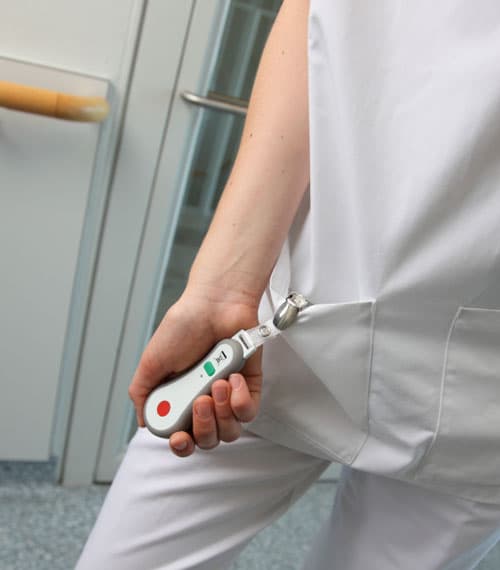
Duress trigger clipped to a clinical uniform and held in the hand
Specification
Body-worn and fixed variants
Specification
Alarm carries wearer location
Specification
Escalates through the same platform as clinical calls
Specification
Optional routing to existing DECT and paging

Staff attack triggers

Body-worn duress transmitters for lone working and public-facing areas: help raised from wherever the incident is, with location attached.

A fixed panic button assumes the incident happens next to the wall. The staff attack trigger removes that assumption: worn on the person, it raises a duress alarm from wherever the wearer is, and the alarm arrives with location attached. Colleagues respond to where the incident actually is.

Alarms escalate through the same platform as clinical calls: the same displays, the same consoles, the same mobile devices, with optional routing to existing DECT and paging estates. The manufacturer's own material names the environments this range was built for (police custody suites, magistrates' courts, detention and remand facilities) alongside hospitals, mental health units and public-facing reception areas. BS 8300 accessible WC alarm integration is cited on the same product line.

Functions

  • Duress alarm raised from the person, wherever the incident is
  • Location reported with the alarm
  • Escalation to the same displays, consoles and mobile devices as clinical calls
  • Optional routing to existing DECT handsets and pagers
  • Ceiling receivers pick up portable infrared triggers in secure environments
  • Accessible WC assistance alarm integration on the same product line, cited against BS 8300

Engineering

  • Runs as an application layer on the nurse call platform
  • Environments named by the manufacturer include police custody suites, magistrates' courts, detention and remand facilities
  • DECT and paging interface capability: specific handset makes and protocols to be confirmed per estate
  • Escalation design (who is alerted, in what order, and what happens if nobody accepts) is configured per site

For specifiers and procurement

What you can download, and what we issue.

Everything the manufacturer publishes for this platform is listed below and opens at source. The second column is our own scope: the documents produced against your drawings when we deliver the system.

Published by the manufacturer

Documents open on Schrack Seconet’s own site, so you always get the current revision rather than a copy that has drifted.

Produced as part of delivery
  • 01System design and specification, written against HTM 08-03
  • 02Call routing, priority, presence and day/night changeover schedules
  • 03Interface schedule for DECT, paging, fire, security and medical device alarms
  • 04Phased migration plan for live wards, bed by bed
  • 05Acceptance test plan and commissioning records
  • 06O&M manual and staff training material at handover
Designed against
  • HTM 08-03
  • BS 8300
  • BS EN 50173-1
  • DIN VDE 0834 (platform certification)

Requesting documentation

Tell us the project and the stage it has reached and we will send the documents that apply to it. Select Healthcare Technology as the service so the request reaches the right engineer.

Request documentation

Conformity declarations, test certificates and warranty terms for the hardware are the manufacturer’s to issue. We reference them rather than restate them, and we will point you to the issuing document for any specific claim you need to verify. Product photography courtesy of Schrack Seconet. Some location hardware shown carries its original manufacturer's markings.

Next step

Bring the complete environment into one conversation.

Tell us what you are planning, replacing, integrating or trying to stabilise. We will help define the right next step.