

ICT Infrastructure
What a wireless survey has to measure before anyone specifies access points
Nexa Tech5 min read
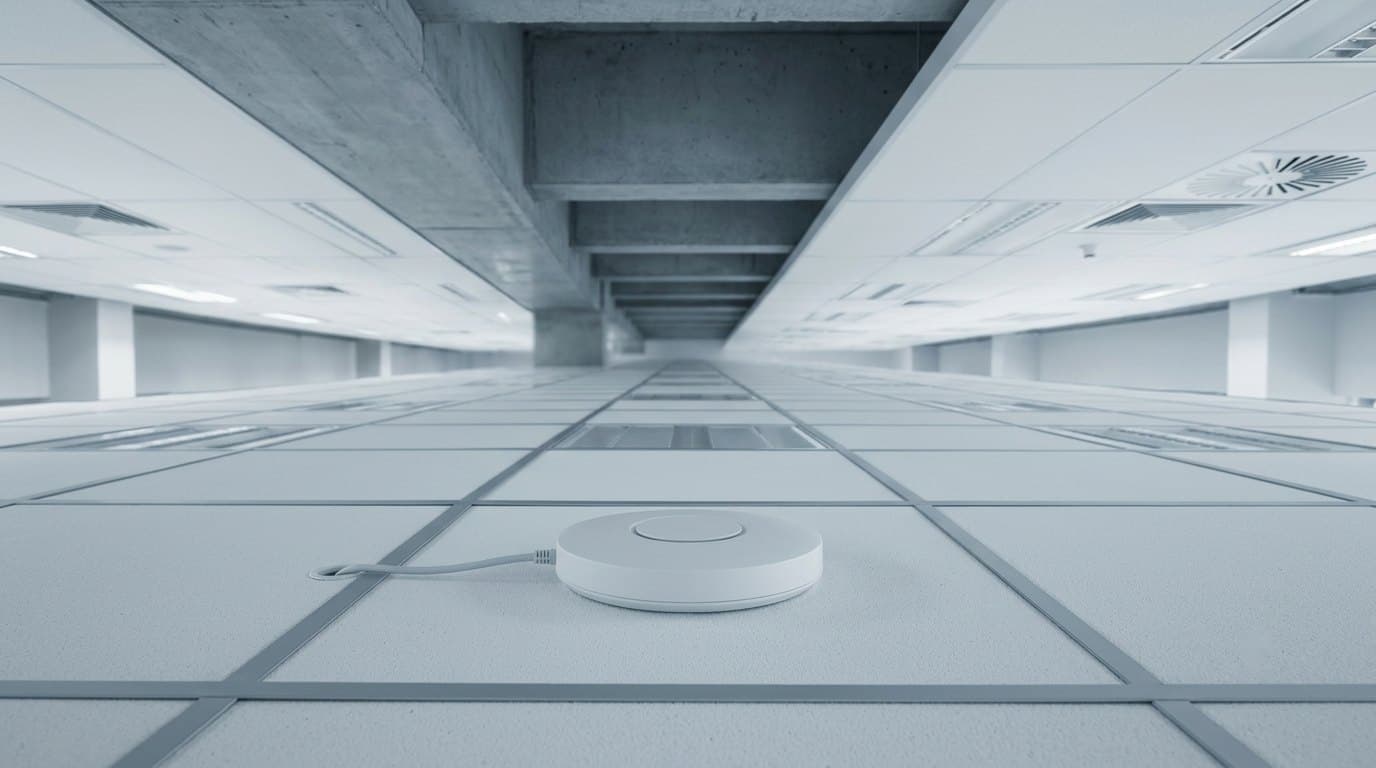
Access point counts are still quoted from floor area. So many square metres, so many radios, agreed before anyone has walked the building.
Coverage is a property of the building. A signal crossing a plasterboard partition loses a few decibels. Crossing blockwork, a shielded imaging room, a fire door or foil-backed insulation, the same signal can lose enough to end the cell, and loses more at 5 or 6 GHz than at 2.4. Two rooms of identical size may need one access point or three. Area cannot tell you which.
What a measured survey establishes
Coverage against a stated target: a signal strength and signal-to-noise ratio every serviced area must meet, per band, at the height the device is used. Measure it with a radio no better than the weakest client, because a survey laptop transmits at higher power and listens on more antennas than a voice handset or a barcode scanner. Design to the laptop and the handset drops the call.
Capacity against device density. Count devices, not metres. Airtime is the constraint rather than headline throughput: a slow client at a cell edge holds the channel far longer per frame than a fast one, and everything else waits.
Roaming against the routes people walk. A client does not roam until its current connection degrades, so the next cell has to be usable before the current one becomes unusable. Overlap is measured along corridors and aisles, at walking pace and at vehicle speed.
Interference as spectrum, not as Wi-Fi alone: what else shares the band, and how much of the time it holds it.
Three buildings, three different problems
A ward is a coverage and roaming problem: small rooms, heavy attenuation, handsets moving between them, and shielded rooms that absorb signal entirely.
A warehouse changes weekly. Racking is the obstruction and stock is the attenuator. A survey of an empty floor describes a building that will not exist once it is filled.
A lecture hall is neither. Coverage is trivial and capacity is the whole job: full signal from one access point, and a network that stops working when three hundred people sit down.
No per-square-metre rule gets all three right.
The survey after the installation
The design survey is a prediction. Installation moves things: an access point lands above a duct or on the wrong side of a steel beam. A switch runs short of power budget, an access point negotiates a lower PoE class, and from then on it runs with fewer transmit chains or a radio disabled.
Validation walks the same routes, against the same target, with the same client type, once the building is furnished and occupied. It records what was delivered, not what was intended. What it finds is cheap to correct while the installer is on site. What it misses becomes "the Wi-Fi is bad", and gets funded as a second project or not at all.
Ask for the signal target, the client device used to measure it, wall attenuation measured rather than assumed, the survey data rather than a rendered heat map, and validation results against that same target. The access point count is an output of that work, not an input to it.
Continue reading

Next step
Bring the complete environment into one conversation.
Tell us what you are planning, replacing, integrating or trying to stabilise. We will help define the right next step.